
Fillers and Injectables
Is Penile Filler Safe? A Urologist Takes You Behind the Scenes
Jul
For a lot of men, the biggest obstacle to booking a consultation for penile girth enhancement isn’t cost, and it isn’t even fear of the procedure itself. It’s simply not knowing what happens once you walk through the door. This is a topic that rarely comes up at dinner parties or in the group chat, and that silence can be enough to keep curious men out of the office entirely.
We sat down with the insights of a board-certified urologist specializing in sexual, hormonal, and genitourinary health to pull back the curtain on what actually happens during a filler consultation, what the product is, how the procedure works, what the research says about safety, and what recovery really looks like. If you’ve been quietly Googling “is penile filler safe” at 1 a.m., this is the honest, unglamorous answer.
What’s Actually in the Syringe
The first thing worth understanding is that not all fillers are created equal, and the choice of product matters enormously. The urologist we spoke with uses a hyaluronic acid (HA) filler that comes prepackaged in single-use syringes, each containing about 1.2 milliliters of product along with a small amount of lidocaine for comfort.
Two details stand out immediately. First, this is a temporary filler, not a permanent one. Second, it’s a commercially manufactured, boxed product, not something mixed or repackaged in-office. That distinction matters more than it might seem, because penile filler can mean wildly different things depending on which clinic you walk into, and not every provider is using a reputable, traceable product.
Why Temporary Beats Permanent
It’s tempting to assume permanent fillers are the better deal why pay for touch-ups when you could have a one-and-done result? But according to the urologist, that logic misses the point entirely. Permanent solutions come with permanent consequences. If something goes wrong with a permanent filler a lump, an infection, scar tissue correcting it is far more difficult than correcting an issue with a temporary product.
This is where risk tolerance becomes the deciding factor in product selection. Most patients coming in for this procedure already have anatomy in the normal range; they’re not correcting a medical problem, they’re pursuing an elective enhancement. And for an elective procedure, the calculus changes. Nobody wants to trade a confidence boost for a lifelong complication. So when a treatment is both effective and reversible, that combination not permanence is what actually represents the safer long-term bet. Based on published research and years of clinical experience, temporary hyaluronic acid fillers currently represent the safest option available for this specific use.
It’s also worth noting that not all HA products feel the same once injected. The formulation used in this protocol is intentionally soft rather than firm, so it mimics natural tissue rather than sitting under the skin like a hard implant. Even during an erection, when erectile tissue pushes against the filler, patients don’t typically report it feeling artificial or firm the tissue moves the way it normally would.
How the Procedure Actually Works
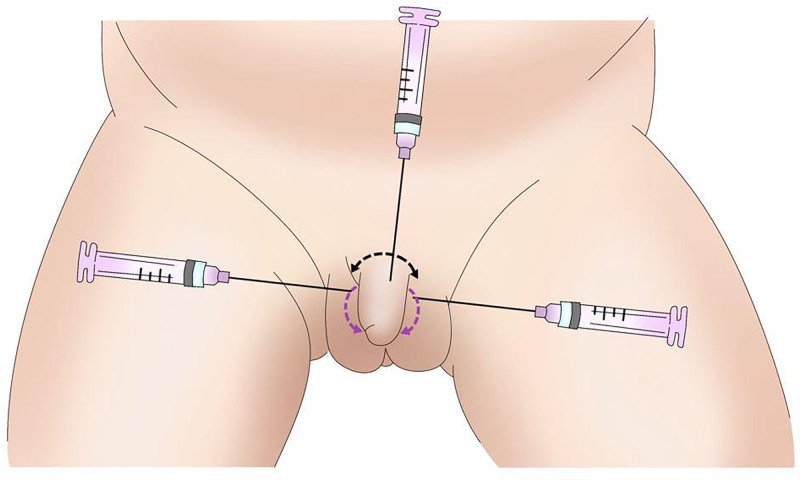
Contrary to popular believes, the penile enlargement with hyaluronic acid isn’t a single dramatic session that delivers a finished result. It’s a staged, incremental process. On average, each treatment session adds somewhere between a quarter-inch and a third-inch of girth, using four to six syringes of filler per visit.
That’s a notably conservative approach compared to some published international studies, which have used around 20 syringes in a single sitting. The rationale for spreading treatment across multiple smaller sessions instead of one large one comes down to control. When a large volume of filler is placed all at once and any of it shifts during healing, correcting that unevenness can become an expensive, time-consuming process. Smaller, staged sessions let the provider observe how the tissue settles, make adjustments in real time, and even out any asymmetry before adding more product.
There’s a physiological bonus to this approach, too. After the first session, the body forms a natural capsule of tissue around the filler. Subsequent sessions can inject directly into that existing capsule, which helps keep the new filler anchored in place rather than migrating.
If unevenness does occur, hyaluronic acid has a built-in safety valve that permanent fillers don’t: it can be dissolved with an enzyme called hyaluronidase. In practice, this “reset button” is rarely needed. Because the staged sessions allow for continuous fine-tuning, most patients reach their desired result without ever requiring correction.
What the Safety Data Actually Shows
Confidence in a procedure should be based on data, not marketing copy, so here’s what the numbers say. A retrospective safety study reviewed 471 men treated at a dedicated penile filler clinic between 2020 and 2023. Among that group, only two patients developed a superficial infection and notably, both were men who didn’t follow the post-procedure protocol and resumed sexual activity too soon.
Just as significant: none of the 471 patients reported worsened erectile function or diminished sensation following treatment. That’s a meaningful data point for anyone worried that adding filler might interfere with normal sexual function. Across this patient population, the procedure was well tolerated.
It’s also fair to acknowledge the open questions. Researchers are still working out exactly how long the filler lasts in the body, and that uncertainty isn’t due to a lack of interest it’s a data-collection challenge. Patients don’t all follow identical schedules. Some return every three weeks for four consecutive sessions and consider themselves finished. Others travel frequently and pop in every few months, or once every six months, depending on their own schedule. Because measurements are taken before injecting (not immediately after, when swelling and local anesthetic would distort the numbers), and because follow-up visits happen at irregular intervals, pinning down a precise “average duration” is genuinely difficult.
The current best estimate is that results last somewhere in the range of 12 to 18 months, though anecdotal reports from patients treated years ago suggest results can persist for four to six years. As a useful comparison: facial filler in areas like the lips can last up to about 12 months, and Botox results vary from six weeks to six months or more depending on the individual’s metabolism. The penis appears to follow the same general pattern a gradual reabsorption process that varies person to person, rather than a hard expiration date.
Out of hundreds of patients, only a single case stood out as an outlier: a man who had received filler from a different provider prior to this clinic lost his results unusually quickly. Every other patient the urologist has treated has maintained results in line with expectations.
Recovery Isn’t an Afterthought
If the injection itself is only half the procedure, the post-treatment protocol is the other half and arguably the more important one. Once a patient leaves the office, the tissue is going to expand and retract naturally with normal erections, and the goal is to keep the newly placed filler exactly where it was placed.
This is where a compression garment comes in a custom-fitted sleeve worn over the penis in the weeks following treatment. It’s designed with an internal ridge to prevent the penis from retracting into the sleeve, and it applies gentle compression that helps minimize bruising, swelling, and shifting of the filler. Patients typically wear it consistently for about three weeks after each session.
One question that comes up often: because filler is injected along the sides of the shaft (avoiding the underside, where the urethra runs), will the result look unnaturally flat? In practice, the compression sleeve plays a big role in rounding out the shape over the following weeks, and even minor irregularities tend to smooth out with continued sleeve use.
Patients are also advised to avoid sexual activity for a period after treatment a protocol detail that, per the safety data above, is directly tied to infection risk. The two infections identified in the 471-patient study both involved patients who resumed sexual contact too soon.
The Off-Label Conversation Nobody Skips
Here’s something every reputable provider should be telling patients upfront, and it’s worth repeating clearly: the hyaluronic acid filler used for this procedure is not FDA-approved for use in the penis. It’s approved for certain facial indications, and its use here is off-label.
Off-label use is a normal, legal part of medicine physicians prescribe and use FDA-approved products outside their labeled indication all the time, guided by clinical judgment and published evidence. But transparency about that status is essential, not optional. Patients deserve to know exactly what they’re getting and why a provider believes it’s a reasonable choice despite the lack of a penile-specific approval. In this case, that confidence is grounded in a strong safety track record from decades of facial use, plus a growing body of penile-specific safety and outcomes data, including the study referenced above.
Who’s a Good Candidate
Not every consultation ends with a same-day procedure and that’s by design, not a failure of the process. Most patients complete their consultation, review an informed consent document at their own pace, and choose to move forward with treatment that day. But there are cases where a provider will recommend waiting.
Men who have experienced erectile dysfunction, or who have lost length or girth due to another condition, may be better served by first working on tissue rehabilitation using tools like traction devices or vacuum therapy before adding filler. In those situations, a cautious provider will often suggest addressing the underlying issue first and revisiting filler as a second step, rather than layering a cosmetic procedure on top of an unresolved medical one.
The Bottom Line
Penile filler isn’t a mystery procedure shrouded in secrecy, it just hasn’t had the public conversation that other cosmetic treatments have. Based on the clinical picture: a temporary, reversible HA filler; a staged treatment protocol designed to minimize complications; a compression-based recovery plan; and safety data showing very low complication rates across hundreds of patients.
That doesn’t mean the decision should be made lightly. It’s still an elective, off-label procedure, and outcomes depend heavily on choosing an experienced, board-certified provider who uses a reputable product and follows a structured post-procedure protocol. But for men wondering whether this is a legitimate, medically grounded option — the honest answer is yes, when it’s done right.
